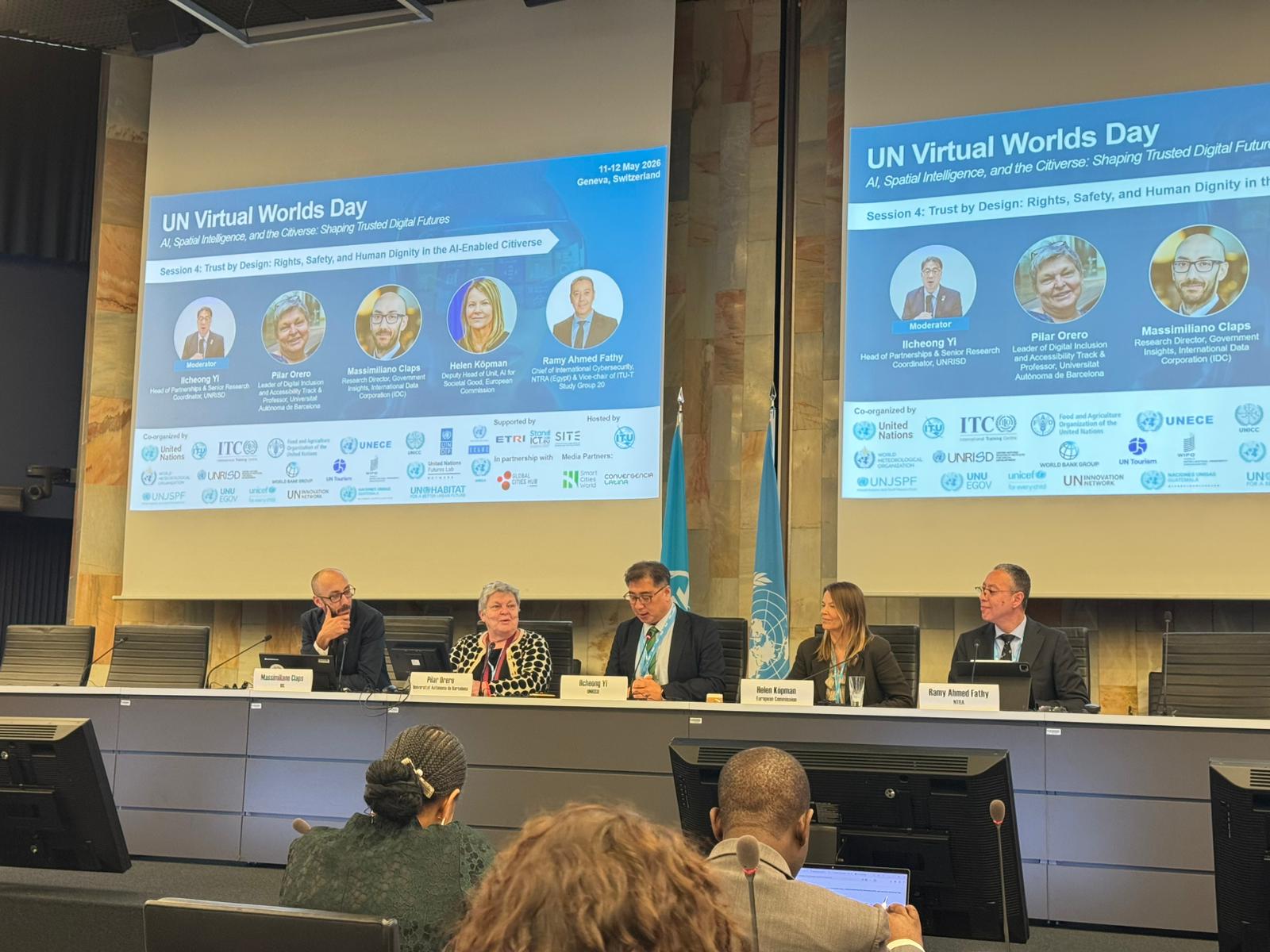
Researcher Pilar Orero takes part, for the third consecutive year, in the United Nations Virtual Worlds Day, an international conference bringing together representatives from states and major global organisations.
The UN has held the third edition of UN Virtual Worlds Day. This global gathering brings together leaders, innovators, professionals, and digital experts to explore virtual worlds, including artificial intelligence, the metaverse, virtual reality, computing environments, and other related technologies. The aim was to foster dialogue, debate, and reflection on their challenges, opportunities, and potential in achieving the SDGs (Sustainable Development Goals), as well as advancing the Pact for the Future and the Global Digital Compact.
This year’s edition took place in Geneva, at the headquarters of the ITU (International Telecommunication Union), a UN agency and the main organiser of the event, which was supported by around ten international organisations.
The TransMedia Catalonia research group took part for the third consecutive year with researcher Pilar Orero, who was one of the speakers in the panel discussion “Trust by design: rights, safety and human dignity in the AI-enabled metaverse.” The session highlighted that, when designing with AI, security, reliability, and accessibility should not be seen as constraints on innovation and technological progress, but as guarantees that underpin the sustainability, competitiveness, and longevity of technology.
As Orero explains, “taking part in the UN Virtual Worlds Day was highly significant, as we succeeded in ensuring that accessibility plays an important role in global virtual world policies”. She also notes that they were able to present the work performed by the AccessCat Network and transfer their research to key stakeholders in digital policy “within a global context framed by the UN”.
This is not the only standardisation activity in which TransMedia Catalonia has been involved lately. Alongside UN Virtual Worlds Day, they presented a contribution to SG20 (Study Group 20), specifically to Q8 (Question 8). The contribution, which also includes researchers Anna Matamala and Estel·la Oncins, explores various aspects of accessibility in immersive and virtual environments. You can read the contribution here and find more information about the ITU standardisation process here.