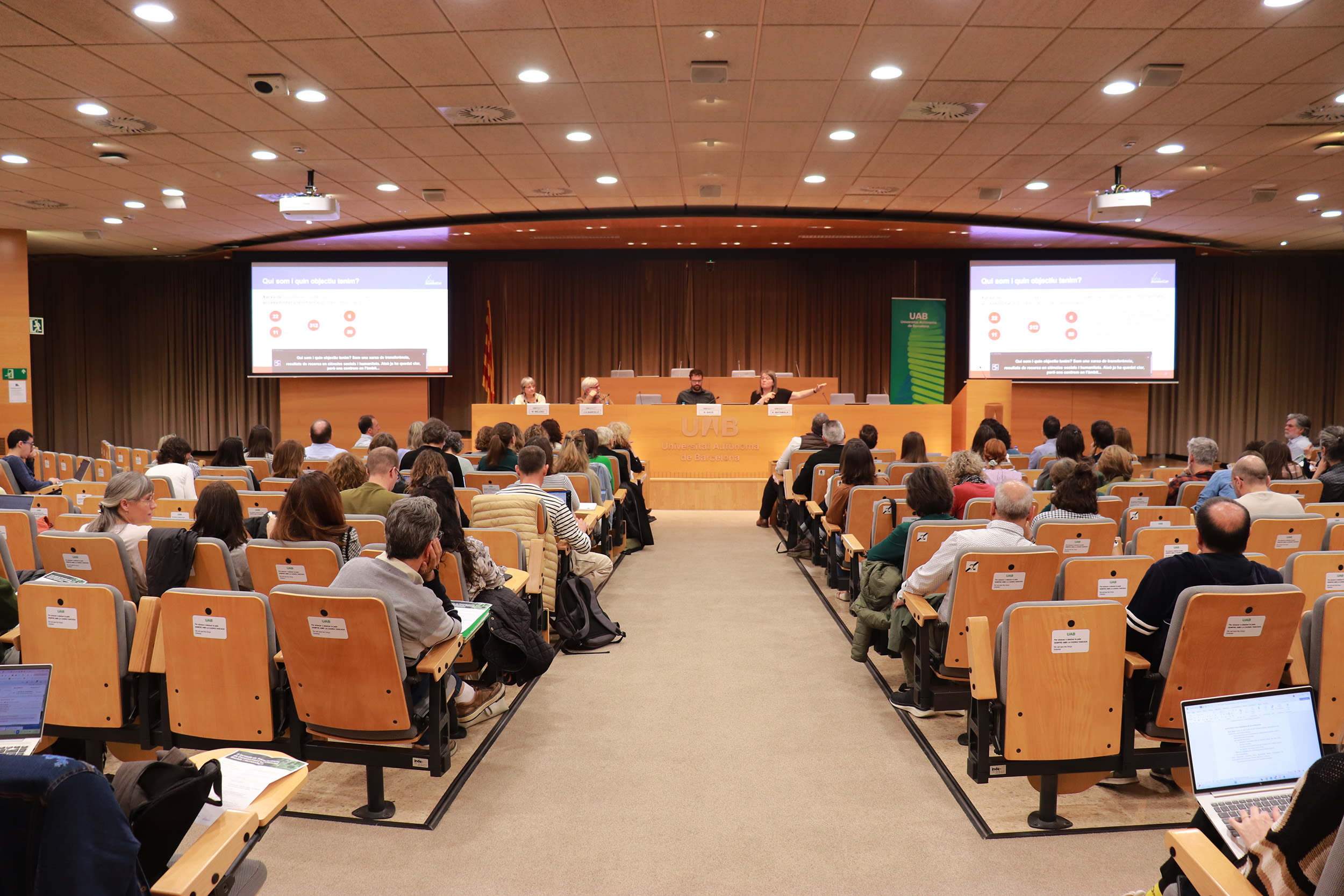
The 2nd Knowledge Transfer Conference in Social Sciences and Humanities brought together over a hundred representatives from universities, researchers and knowledge transfer experts.
Two years ago, the AccessCat Network brought together more than 200 people interested in exploring what makes knowledge transfer in the social sciences and humanities (SSH) unique and how its impact should be assessed. That first event concluded with a commitment to meet again in the future to explore progress in the field. Accordingly, on 16 April, the UAB hosted the 2nd Knowledge Transfer Conference in Social Sciences and Humanities, focused on showcasing transfer tools, sharing success stories and creating new opportunities between universities, public administrations and businesses.
The event began with an institutional welcome from Lourdes Puigbarraca, Deputy Director-General for Knowledge Transfer and Knowledge Society at the Government of Catalonia’s Department of Research and Universities, and Rosa María Sebastián, Vice-Rector for Innovation, Transfer and Entrepreneurship at the UAB. Both highlighted one of the key pillars of knowledge transfer: ensuring that research listens to society, so that it can respond to real-world challenges and collaborate closely with its social and business ecosystem.
The first session focused on UAB services and units that support knowledge transfer, presenting tools that empower entrepreneurs and resources that connect research with companies, public administrations and potential spin-off catalysts. As Ivan Martínez, UAB Vice-Manager for Research, explained, “through technical staff, research groups have many tools at their disposal to strengthen their work”.
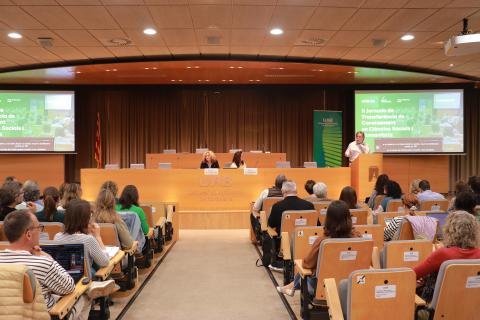
The conference continued with a session on R&D&I networks, particularly those focused on SSH, as these fields are not isolated but engage directly with other sciences and technologies. As Nadal Bayà, Head of the Knowledge Transfer Area at AGAUR, explained, “SSH includes clearly technological components and involves collaboration with other sectors. It is important to understand that its impact extends across all fields”.
Speakers in this session included Anna Matamala, Director of the AccessCat Network, who highlighted the qualitative progress made between the first and second editions in understanding SSH knowledge transfer, and Maite Melero, from the Barcelona Supercomputing Center, who presented CLARIAH-CAT, a newly established network focused on digital humanities, outlining its background and roadmap for its first three years promoting SSH transfer.
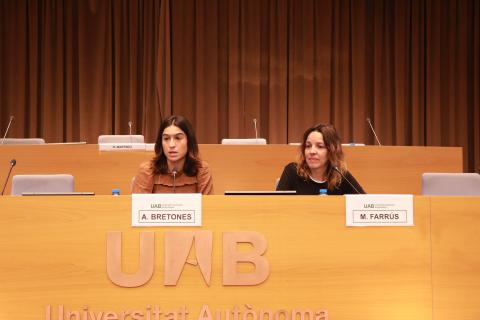
The second block of the conference explored knowledge transfer through successful case studies. Among others, Mireia Farrús, from the CLiC research group and an AccessCat member, presented SCRIBAL, a digital transcription tool for teaching linked to language technologies and accessibility, which was also used to provide live subtitles during the event. Miquel Domènech, from the STS-b research group, also spoke about the importance of co-creation between universities and the public sector.
The final session featured a special segment on standardisation led by Anna Matamala. She explained how her group, TransMedia Catalonia, along with an increasing number of AccessCat researchers, actively contributes to the development of standards and high-level documents in European and international bodies to ensure accessibility is included in public policy. “As researchers, it is important to engage in standardisation, as this ensures our research has real impact and direct application in the products and services that reach society and affect everyone,” she stated.
The closing remarks were delivered by Rosa María Sebastián, who highlighted six key recurring ideas from the conference:
- the importance of co-creation with the private sector;
- citizen science and involving society in research;
- continuous knowledge transfer;
- translating science into practical applications;
- maintaining active transfer ecosystems through communication between researchers and institutions;
- and the need to increase the visibility of research, which means that institutions need to facilitate access to their tools and technologies.
The event gathered more than 200 participants, including researchers, knowledge transfer professionals and representatives from universities and public administrations. A strong turnout that enabled essential discussions to advance knowledge valorisation and transfer in the social sciences and humanities.
You can watch the recording of the conference here [in Catalan].