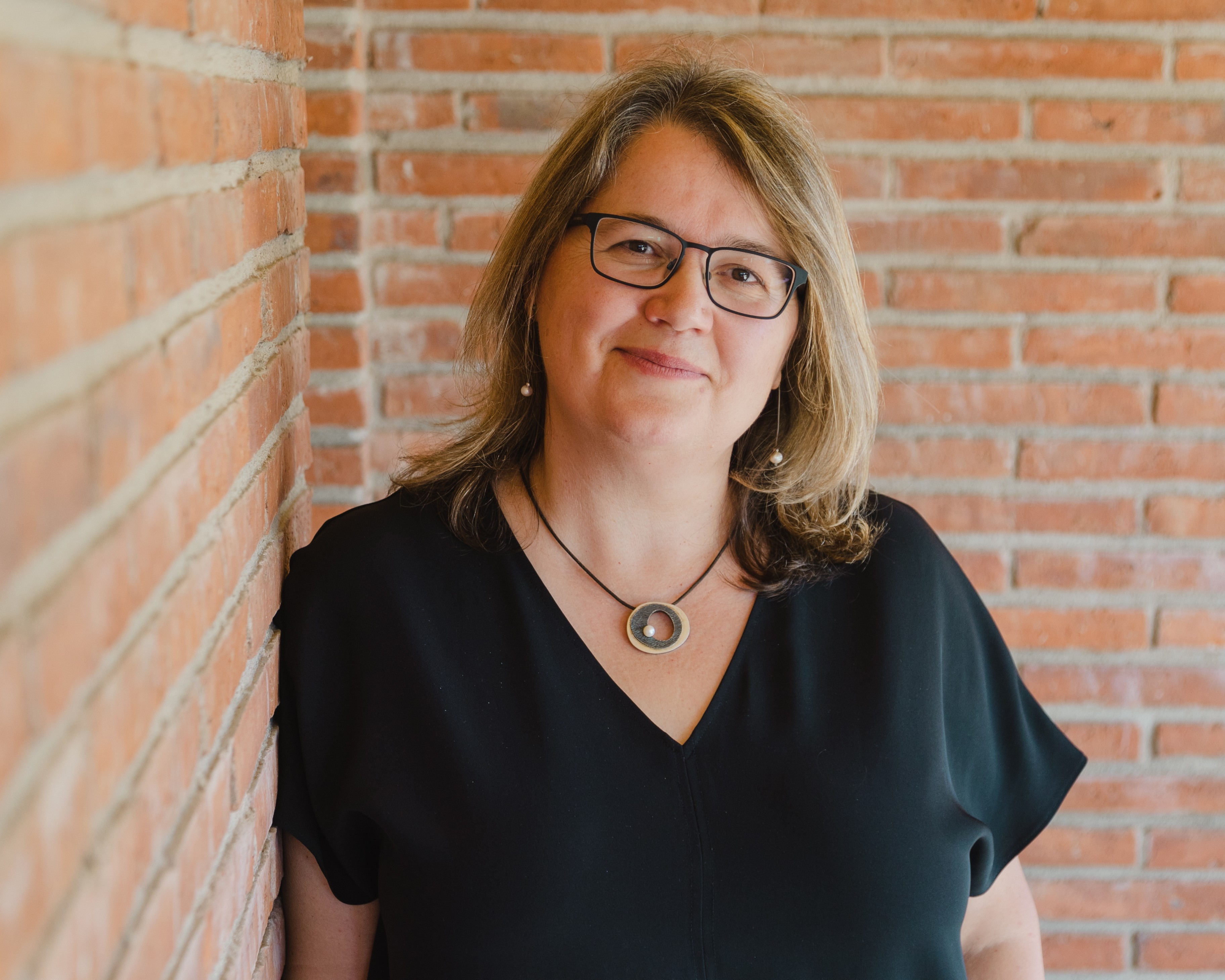
“We want people to think of us whenever they need a technology, a service, an educational resource, or training in accessibility,” she explains in this conversation about the Network’s past, present, and future.
The AccessCat Network was established in 2023 with the aim of becoming, over a three-year period, a benchmark in knowledge transfer on accessibility to information and communication. The Government of Catalonia has now renewed its support for the Network, which will receive funding to continue its work during the 2026–2028 period. For this reason, we spoke with AccessCat’s director, Anna Matamala, about the Network’s past, present, and future.
How did the network come to be?
In 2022, a call for funding was launched for R&D&I networks to carry out programmes for the valorisation and transfer of research results during the 2023–2025 period. Blanca Arias, who had been a postdoctoral researcher in the TransMedia Catalonia group and had obtained a position at the UPF, asked Pilar Orero and myself what we thought about applying to create a network.
We were not sure whether we would fit in. It seemed that no previous network matched the profile we were proposing: focused on accessibility to information and communication, less technological, with a profile centred on Social Sciences and Humanities and a smaller number of groups. However, my intuition told me that we should try to do something different.
We were keen to see a Catalan network become a benchmark in accessibility. There is research in the field and a clear social need. What was missing was a bridge. We contacted all the groups we knew that were working on accessibility to information and communication in Catalonia and, together with those who responded (12 groups) and with the support of 38 affiliate entities, we submitted a proposal that was funded from 2023 to 2025.
Over these years, we have grown: we now have 20 research groups and 76 affiliate entities, and the new proposal includes even more members.
Why has it been important to create and fund a network like AccessCat?
On the one hand, because of the issue that brings us together. Without accessibility, there are no human rights. Without accessibility, there is no education, no civic participation, no culture, and no access to information. Moreover, following the entry into force of the European Accessibility Act and the approval of the Catalan Accessibility Code, we are at a moment when accessibility measures need to be implemented across a wide range of environments. AccessCat can help by providing solutions and training from its groups and by building bridges between different stakeholders.
On the other hand, because this is a network made up of researchers from diverse disciplines, with a strong Social Sciences and Humanities component. This has been challenging, as there were no reference networks in this field in Catalonia and because, beyond traditional technological transfer indicators, we need other indicators focused on social impact.
Did you expect such a positive response?
To be honest, when I submitted the proposal, I was convinced of its value, but I was not sure how it would be received. It was a case of “let’s try and see what happens.” I knew our network would be different: While we can foster technological transfer, we can also do many other things that may be less recognised, such as transferring methodologies, contributing to public policies, or taking part in standardisation activities. But we all needed to mobilise, increase our transfer culture and explain other valid models, and I am very pleased to see that this has happened.
How do you assess what has been achieved in the first three years?
Thanks to teamwork, we have achieved all the objectives we set ourselves. We wanted to become a benchmark in accessibility to information and communication, with a particular focus on education, media, and culture, and I believe we have achieved this, with visibility not only in Catalonia but also across Europe.
Among other actions, we have carried out transfer and innovation activities, provided tools, resources, and support to the groups, launched funding calls, participated in national and international fairs, offered training—such as the AccessCat Training Capsules, short free online videos that have been very well received—and we have been selected as a best practice by the European Commission’s Knowledge Valorisation Platform.
How does AccessCat approach the 2026–2028 period? What are the main changes?
We are very satisfied with what we have achieved, but we are not complacent. We will therefore introduce changes to help us improve. We now consist of 22 research groups from 11 institutions and 80 affiliate entities, to which 6 business, social, and public administration entities have been added, giving us access to 1,768 companies, organisations, and institutions. This will allow us to further strengthen relationships between research groups and other ecosystem stakeholders.
We want university technology transfer offices to play a more active role, which is why we are including them in the Advisory Board. We are expanding the management team with the addition of a strategy manager or business developer, who will drive the Network’s business dimension and play a key role in AccessCat’s internationalisation. We will also consolidate collaboration with Catalan R&D&I networks, which we will coordinate during 2026.
We are maintaining annual calls to support valorisation, internationalisation, and standardisation activities, as well as calls to support disruptive solutions. In addition, we will develop more agile mechanisms in the form of vouchers and adopt a more proactive approach towards solutions with greater potential.
What are your expectations for this period?
I hope we will consolidate ourselves as a reference network in accessibility to information and communication. That whenever someone needs a technology, a service, an educational resource or training, they think of us first, so that we can act as a bridge between researchers, companies, public administrations, and society. I also hope that the culture of knowledge transfer will grow, valuing different ways of valorising knowledge.
I hope we will successfully carry out the eight major planned actions: expanding the catalogue of technologies, services and resources on our website; offering internal training on transfer and external training on accessibility; funding communicative accessibility solutions; funding awareness-raising, dissemination, and engagement actions with the business and social sectors; funding internationalisation and standardisation activities; identifying good transfer practices in Social Sciences and Humanities and discussing how to measure social impact; and collaborating with other networks to achieve an even greater multiplier effect.
What are the main future challenges for the Network?
A first challenge is to increase collaboration between different stakeholders. This is why we have incorporated business and public administration entities, in addition to social organisations. We must not forget that the ultimate goal is for our solutions to have an impact on people, making collaboration with user organisations essential.
A second challenge is to increase internationalisation, which is why the new proposal includes funding for several international missions.
A third challenge is to demonstrate the social impact generated by knowledge transfer in Social Sciences and Humanities. To this end, we will carry out various activities and highlight good practices developed within AccessCat. We face this new stage with great enthusiasm and a strong desire to continue “planting seeds for accessibility.”